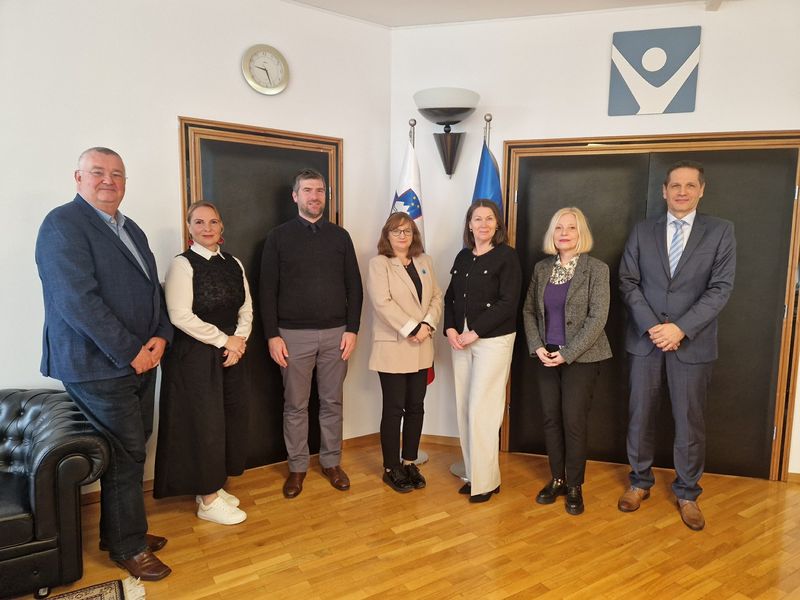
The President of the Court of Audit of the Republic of Slovenia, Jana Ahčin, and her Deputy Presidents, mag. Maja Bilbija and mag. Aleksej Šinigoj, paid official visit to the Human Rights Ombudsman, dr. Simona Drenik Bavdek, and her co-workers. Deputy Ombudsmans, Miha Horvat, Ivan Šelih and dr. Dijana Možina Zupanc, also attended the meeting.
The participants emphasised the importance of cooperation among independent supervisory institutions in Slovenia, namely the Human Rights Ombudsman, the Court of Audit of the Republic of Slovenia, the Constitutional Court of the Republic of Slovenia, the Commission for the Prevention of Corruption, the Advocate of the Principle of Equality, and the Information Commissioner. “Cooperation strengthens our independence and proficiency, as well as efficiency,” stated the Ombudsman. The President of the Court of Audit, Jana Ahčin, added that constructive collaboration, especially in protecting independence, is relevant for both institutions since there are certain common and overlapping directions of their operation.
In this regard, the Human Rights Ombudsman has been for many years pointing out the importance of independent State institutions for safeguarding human rights and fundamental freedoms, for the functioning of democratic society and guaranteeing the rule of law based on the well-established system of checks and balances. “People's trust in the State's ability to safeguard constitutionally provided rights depends upon the effective system of checks and balances and upon building citizens' trust in the system. And national human rights institutions are recognised as pillars of democratic resilience,” believes dr. Simona Drenik Bavdek who proposed closer content-level cooperation with the Court of Audit. This would include performance audits of the use of budgetary resources since it is essential to consider assessment of the situation from the aspect of safeguarding human rights.
The Ombudsman noted that various political actors by doubting the professionalism of independent institutions in Slovenia build up pressure on their effective independence and impartiality. “Independent institutions from other European countries are facing similar pressure as regards both decision-making independence and selected contents submitted for consideration,” concluded the Ombudsman.