
The European Court of Auditors (ECA) and the Court of Audit of the Republic of Slovenia organised a round table Recovery and Resilience Mechanism – challenges and opportunities, which was held in the House of the EU in Ljubljana on 24 October 2025.
The event conducted by Damijan Fišer from the ECA was aimed to discuss finalisation of the Recovery and Resilience Mechanism (RRF) whereby Member States need to submit the final payment requests in one year. Participants talked about the experiences of Member States, the European Commission and supervisory bodies. They shared their opinions on what should be kept and what should be changed in the existing mechanism considering the new multi-annual financial framework of the EU.
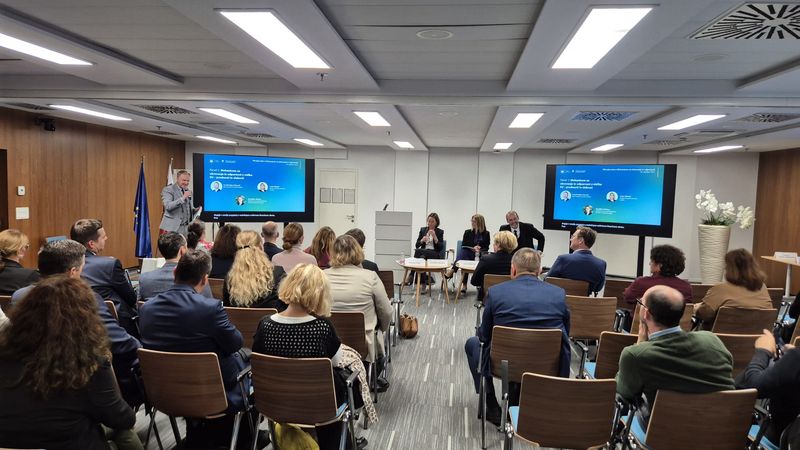
In his introductory speech the participants were addressed by mag. Jorg Kristijan Petrovič, Slovenian member of the ECA, who together with Croatian member of the ECA Ivana Maletić and Geraldine Mahieu, acting director in charge of Investment, growth and structural reforms at Directorate General for Economic and Financial Affairs (DG ECFIN.B) of the European Commission, presented advantages and disadvantages of the Recovery and Resilience Mechanism from the EU perspective.
The representative of the European Commission dealt with the current situation related to the implementation, how many targets and objectives need to be met before the end of August 2026 and how much funds is still available for absorption by the end of next year. A special attention was given to the already achieved objectives, results and impacts, as well as links among the RRF and structural changes in the Member States, control mechanisms and impacts on proposed long-term EU budget that shall maintain certain elements of the RRF.
The representatives of the European Court of Auditors focused on the review of effectiveness of the RRF implementation from the perspective of accountability, transparency and performance measures. Thereby they pointed out weaknesses of the RRF and lessons to be learnt, considering the proposal of the multi-annual financial framework that shall enter into force in 2028. The findings of the ECA highlighted the fact that the RRF is not an instrument based on performance and thus the participants agreed that future budgets – that shall be based on performance – must be more linked to the results and clearly defined rules otherwise the system should not be applied.
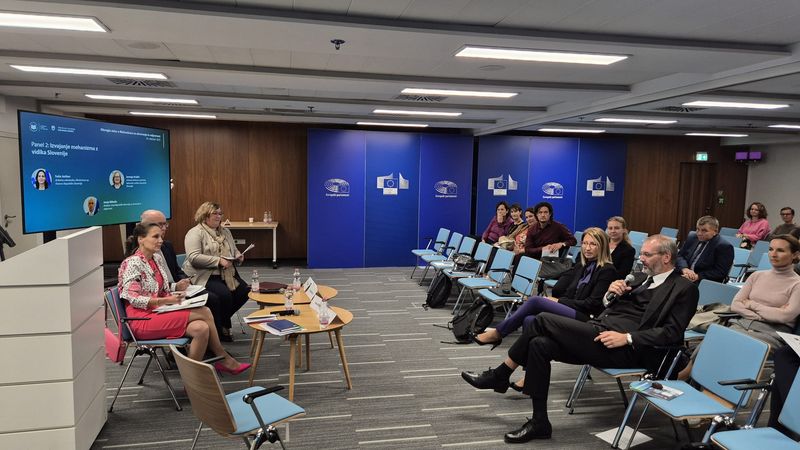
Jerneja Vrabič, Supreme State Auditor of the Court of Audit of the Republic of Slovenia, mag. Saša Jazbec, General Secretary of the Ministry of Finance, and mag. Josip Mihalic, Director of the Office of the Republic of Slovenia for Recovery and Resilience, presented Slovenian experiences with the implementation of the RRF.
Supreme State Auditor Jerneja Vrabič explained the findings from the audit of managing the implementation of the Slovenian Recovery and Resilience Plan and highlighted the differences in approaches and specific challenges faced by auditors when assessing programme effectiveness directed towards the achievement of the results. The discussion included examples of best practice when implementing Slovenian Recovery and Resilience Plan and key challenges when coordinating and following implementation of milestones and objectives. The event was participated by some Members of the European Parliament and stakeholders from Slovenia.